It’s been almost 3 months since Subway Surfers City launched globally.
Since launch, the game has generated over $1.5M in IAP revenue alongside more than 27M downloads.
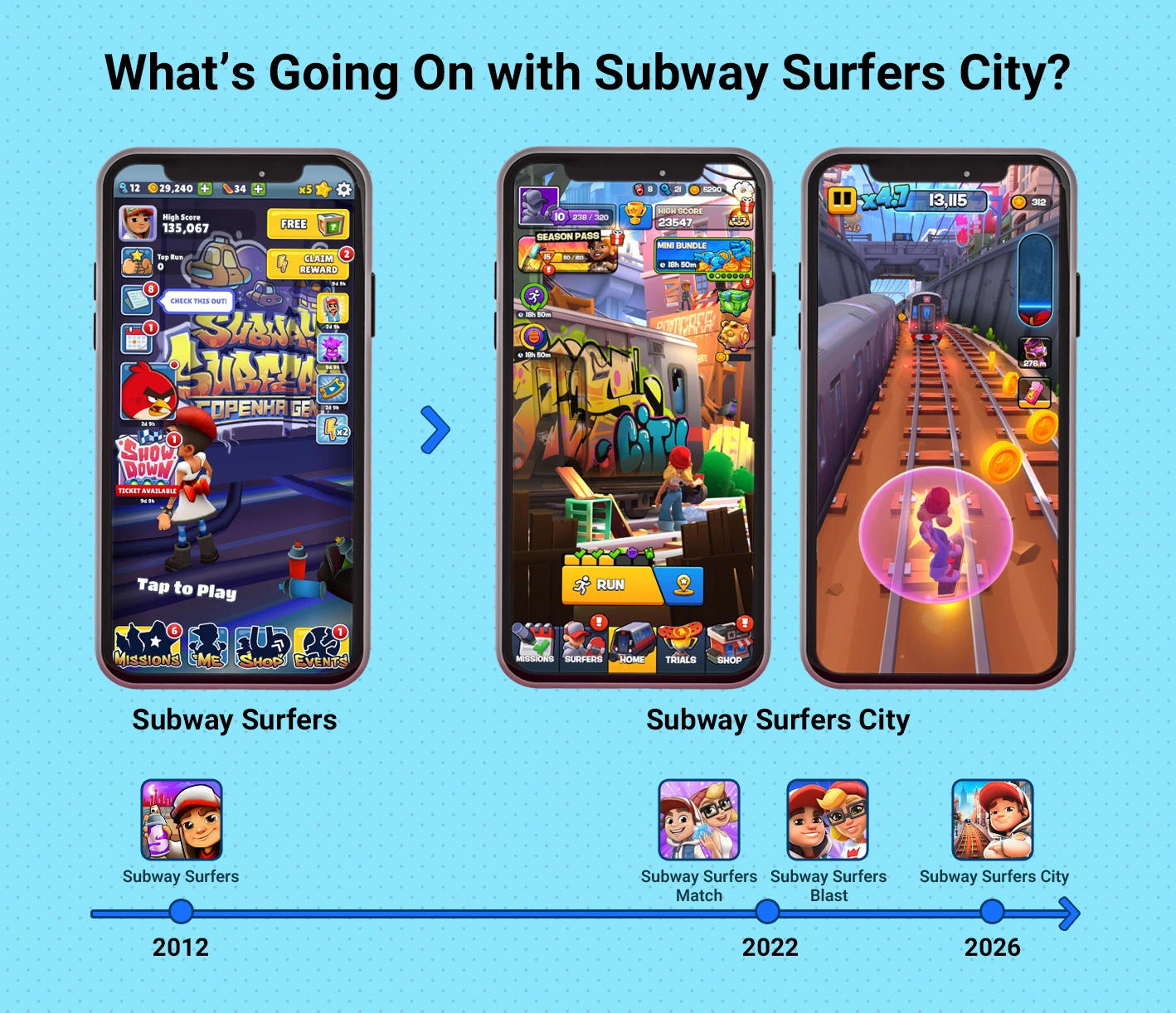
What makes this especially interesting is that the new game arrives nearly 15 years after the original launched. However, this is not the franchise’s first attempt at expanding the Subway Surfers IP beyond the original title.
Before City, there were other spin-offs released in 2022 such as Subway Surfers Match and Subway Surfers Blast. But both eventually failed to sustain enough engagement and were sunset.
However, Subway Surfers City feels much more like a true sequel to the original. The game has been in soft launch since July 2024, and compared to the original, it feels significantly more modernized. Polished visuals, new mechanics, boosters, and challenges make runs feel less repetitive and more dynamic.
But what’s more interesting is how much the game leans toward midcore progression systems. Shard-based gacha systems for character and surfboard upgrades, limited daily score rewards similar to daily reward chests seen in Supercell games, a simplified deck-style loadout system, and multiple currencies all seem designed to push higher LTV compared to the original title.
However, when looking at the performance trends, the game appears to be declining fairly quickly after its launch window.
Subway Surfers City’s monthly IAP revenue has already dropped to around $260K per month, while the original is still doing over $300K in monthly IAP revenue. But IAP revenue only tells less than half the story for endless runners like these, since they are primarily monetized through ads. And compared to the original, Subway Surfers City has introduced new RV ad placements with the help of its deeper progression systems.
The bigger question is whether the game can sustain enough incoming users over time for these deeper systems to truly pay off long term. It will be interesting to see where the game stands in another year.