In the hybrid casual space, puzzle games and battle games continue to be the two biggest focus areas for most publishers.
Within battle games, we usually see Idle RPGs, Action RPGs, Puzzle RPGs, and Tower Defense games. And to make them more mass-market, developers frequently borrow mechanics from a wide range of genres, adapting them into accessible gameplay loops.
Naturally, developers also experimented with bringing Monopoly-inspired board mechanics into battle games.
While more midcore titles such as Rogue Legend and Heroll proved the formula could work, many hybrid casual versions struggled to gain traction. One of the biggest reasons was the higher CPI associated with the traditional Monopoly board itself.
To solve this, developers began simplifying the concept.
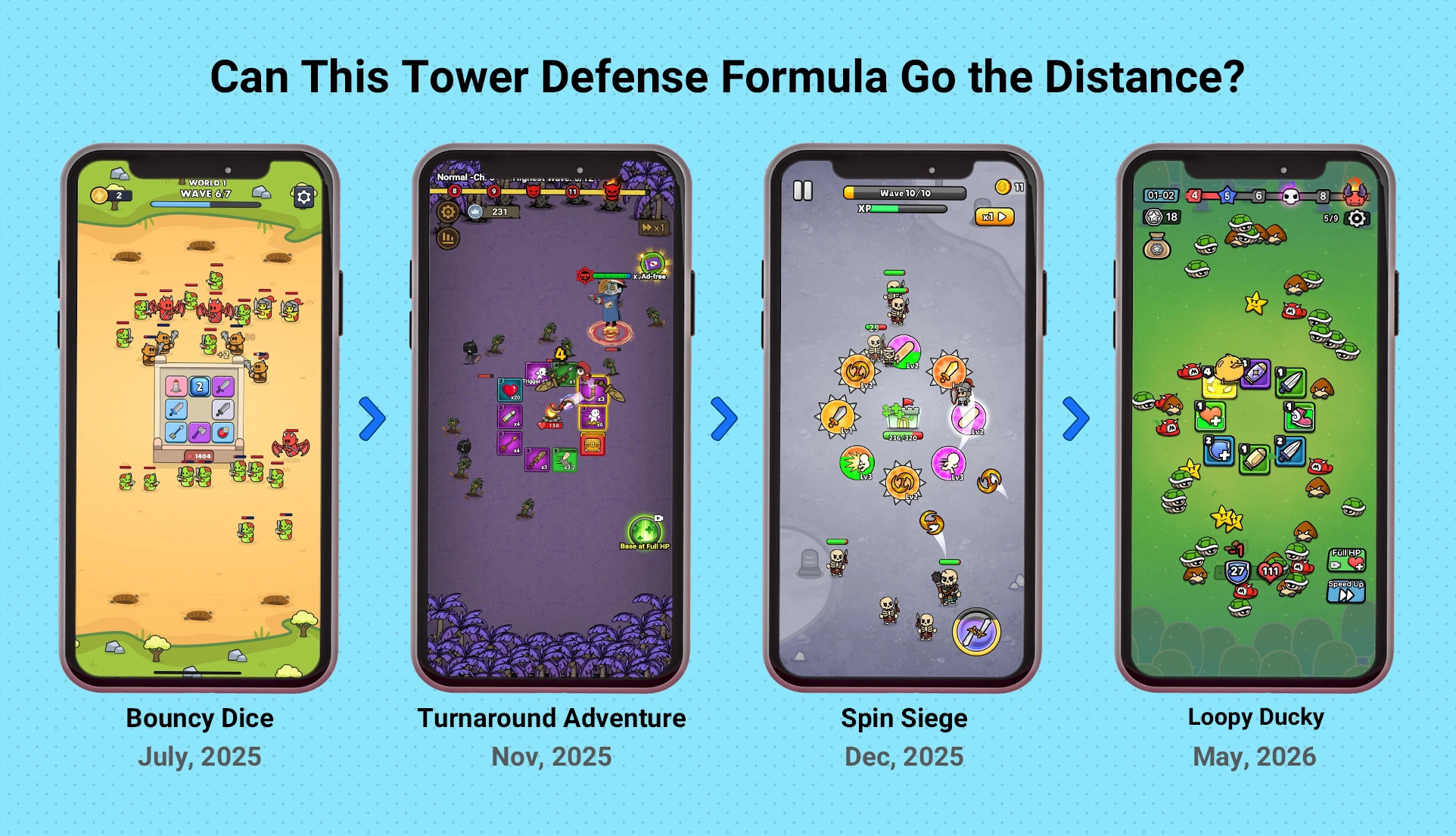
Games like Bouncy Dice by Brew Games introduced much smaller boards while retaining dice-based movement. While this reduced complexity and the upgradeable dice faces created satisfying power progression, it also introduced new issues. Compared to established hybrid casual puzzle RPGs like Gear Fight, these games lacked strategic puzzle depth, and the randomness of dice rolls often made success feel less skill-driven.
Then Turnaround Adventure by SF Group took the idea in a completely different direction.
Instead of relying on dice, the character continuously runs around the board in a loop. Players strategically place attack and skill tiles to maximize the value of every lap. By removing most of the randomness while preserving the satisfying board-building gameplay, the game struck a much stronger balance between accessibility and strategic decision-making.
Since the game was primarily built for the Asian market, it didn’t take long for Western adaptations to appear.
Among them, Rollic‘s recent soft launch, Spin Siege, stands out as the strongest mass-market interpretation so far. It replaces the square grid with circular cells, adopts a more broadly appealing art style, and streamlines progression to better fit hybrid casual audiences.
More games have already started following this direction. Loopy Ducky is essentially a mass-market adaptation of Turnaround Adventure, while Dice Survivor follows a path much closer to Bouncy Dice by keeping dice-based movement.
Historically, adapting successful Asian games for Western audiences has been one of the most reliable ideation strategies in mobile games, and many of those adaptations have gone on to become major hits.
While Turnaround Adventure also showed promising signs of scaling, its performance has gradually declined over time.
The interesting question is whether this board-based Tower Defense variation has enough strategic depth to become a long-lasting subgenre, similar to gear puzzles or backpack puzzles, or whether the gameplay eventually becomes too repetitive once the novelty wears off.
What do you think?