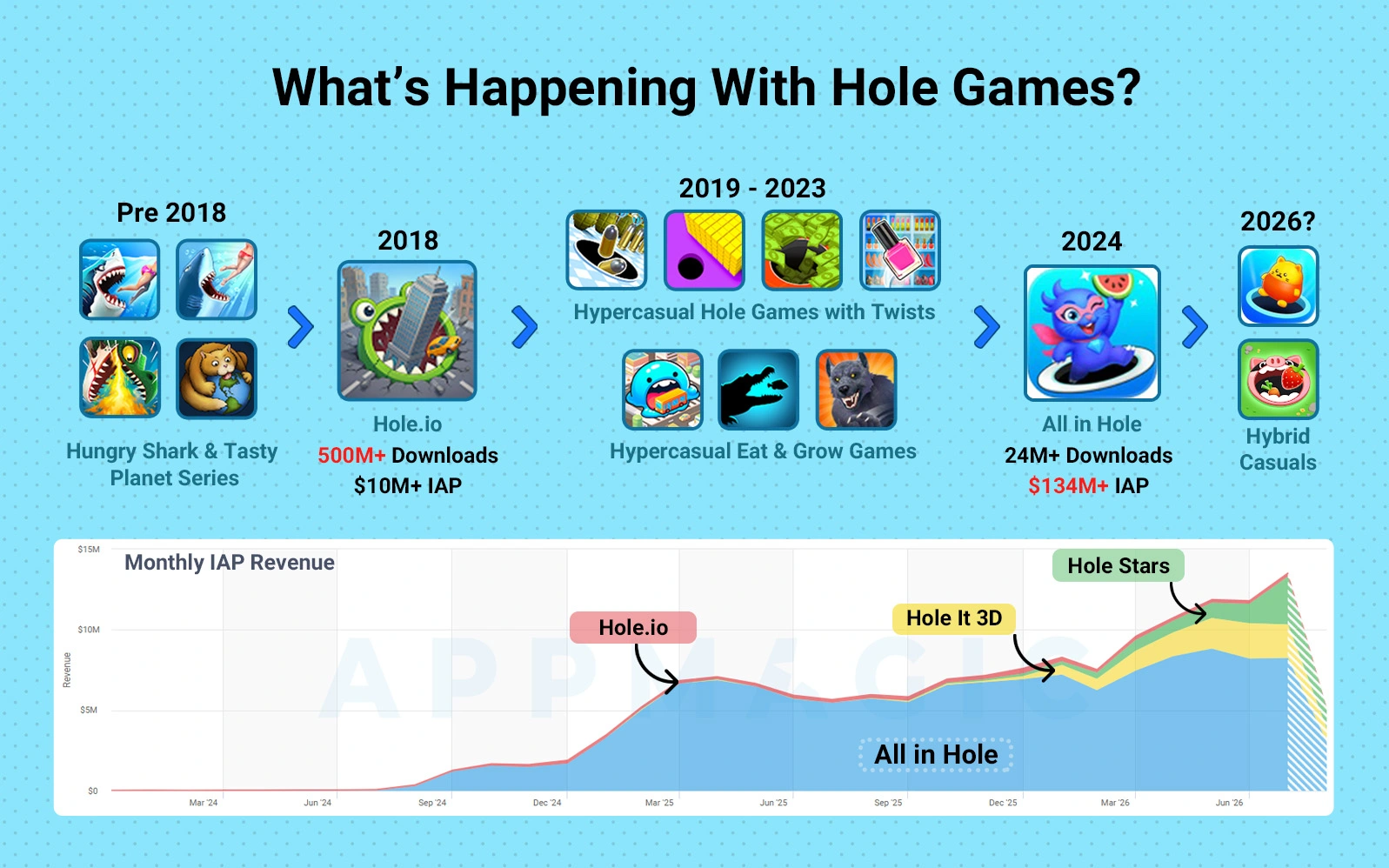
All in Hole has generated over $130M in IAP revenue, while Hole-io has surpassed 500M downloads.
Both use essentially the same toy: a hole that eats things and grows
Yet one became an IAP machine, while the other remains largely driven by ads.
So, where did this hole come from?
Holes have been used across different genres, including puzzle games like Hole People and Down the Hole. But their most successful use has been within the Eat & Grow subgenre.
And it all started with sharks, followed by cats, dragons, worms and plenty of other creatures.
The premise was simple: Eat smaller things, get bigger, and keep eating.
Ubisoft’s Hungry Shark series became one of the biggest examples of this formula, accumulating over 1B downloads across the franchise, led by titles such as Hungry Shark Evolution and Hungry Shark World.
Then, in 2018, the subgenre took a different direction, with Voodoo releasing Hole.io, inspired by then-upcoming PC game Donut County. Instead of controlling an animal, players controlled a hole that grew as it consumed increasingly larger objects.
It was an incredibly simple fit for hypercasual. The mechanic was instantly understandable, the growth was visually obvious, and swallowing increasingly massive objects delivered a strong sense of power progression. So, Hole-io quickly climbed the charts, and naturally, other publishers followed.
Games such as Color Hole 3D by Azur Games and Attack Hole by Homa became some of the biggest iterations. Some twisted the core loop, like Rollic’s Arcade Hole, while others expanded beyond holes but stayed within the same subgenre, with games like Evolution Merge by SayGames experimenting with idle merge mechanics.
Then, in 2024, the hole took another major turn. Homa released All in Hole.
By then, the publisher already had plenty of experience with the subgenre through titles such as Attack Hole, Hole and Fill, and Monster Evolution. This time, they combined the proven hole mechanic with a deeper casual metagame. All in hole started scaling significantly in early 2025 and has remained strong since then, with daily revenue frequently reaching around $200K+
Then once again, the market followed. Even Hole.io went through major transformations, adding deeper progression and metagame systems. While it hasn’t reached All in Hole’s scale on the IAP side, it showed that the same toy can support two very different business models.
Since 2025, there has been around 120 hole games released. Out of them, two stand out. Why?
● Hole It 3D – helped Supersonic to further push into hybrid casual
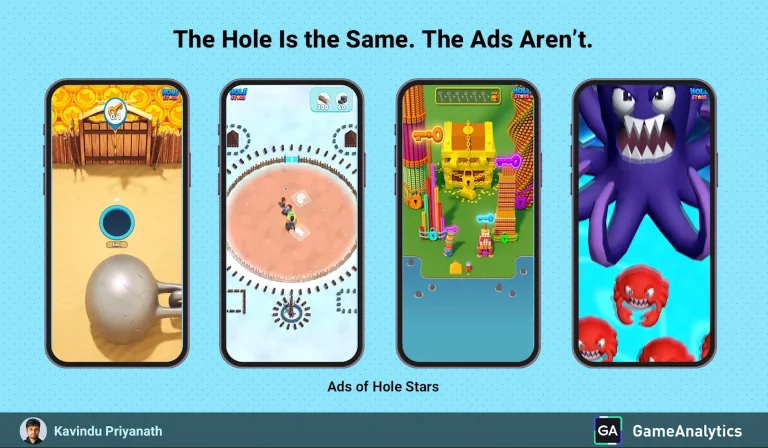
● Hole Stars – gave Moon Active a way to further expand their Coin Master IP
While these are still generating only a fraction of the revenue captured by the market leader, they show that the market doesn’t belong to just one publisher.