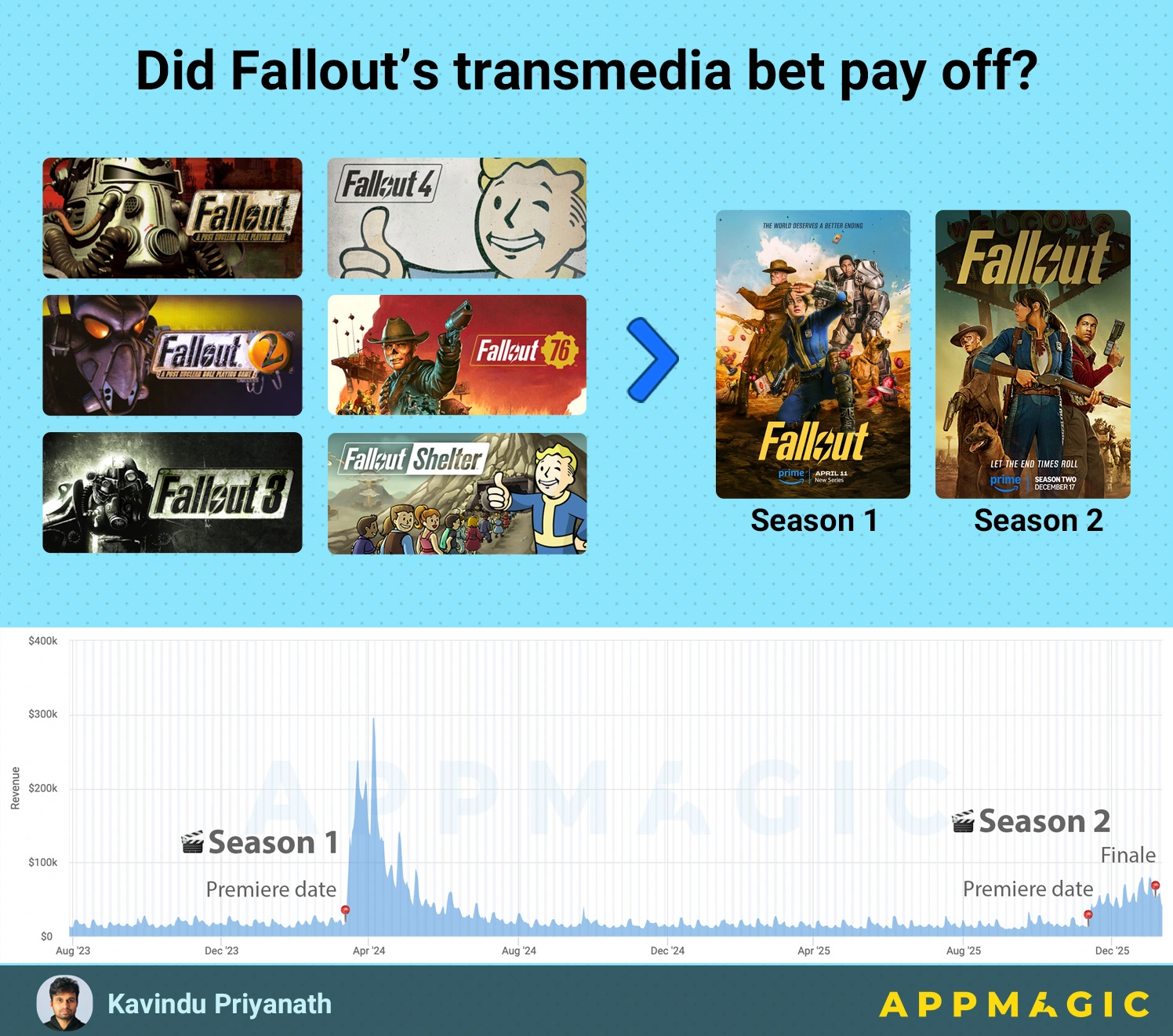
When Amazon’s Fallout Season 1 launched in April 2024, the impact on the games was immediate.
● Fallout Shelter’s daily revenue jumped 10x
● Fallout 4 sold ~900K copies in a single month
● $23M+ combined revenue across major titles in April
It was a textbook transmedia spike, but it didn’t last long. By late 2024, downloads and revenues had returned to baseline.
The hype was real, but short-lived. Then came season 2.
Unlike Season 1, it didn’t drop all episodes at once. It rolled out weekly over nearly two months. Because of this, debut viewing minutes were significantly lower: 794M compared to 2.9B for Season 1. Still, Fallout Shelter’s daily IAP revenue rose about 4x. A strong uplift, but not as explosive as Season 1.
And Bathesda changed the playbook again.
● Two back-to-back in-game seasons
● Casino-themed LiveOps mechanics
● 80-90% Steam discounts
● Expansion content for Fallout 76
And the result?
● ~1.8M Steam downloads during the run
● ~$17.4M revenue across 3 main titles
Instead of chasing another explosive spike, Bethesda appears to have traded peak velocity for a longer revenue tail. Now the real challenge is how long they can sustain that tail.
But the bigger question is: would this have worked without,
● 8+ legacy titles on Steam
● A mobile F2P entry point
● Heavy discount flexibility
● A 25+ year-old IP?
Transmedia can take many forms. Book-to-Game, TV-to-Game, Game-to-TV. Fallout is the latter. And it worked.
But it worked because of scale. Without catalog depth, pricing leverage, and LiveOps infrastructure ready before the spotlight hits, the spike simply burns out.
Check out the full deep dive by AppMagic to explore this in more detail.