Idle games have been evolving for years. From browser-based clickers to mobile F2P giants and Steam’s ecosystem, the genre has continuously reinvented itself across platforms.
And in 2026, Steam feels like one of the most interesting places to observe that evolution unfold.
AppMagic‘s recent research shows exactly why, highlighting how Idle games on Steam are no longer just ‘games that play themselves’.
Genre Positioning
Steam Idle games often show very strong D1 retention, usually ranging from 40% to 70%, but with relatively lower D30 retention. That’s mainly because these games are not built around massive content pipelines, but strong system driven loops focused on passive progression and satisfying feedback loops. This works especially well with their common $3-$15 pricing range, making them easy impulse purchases.
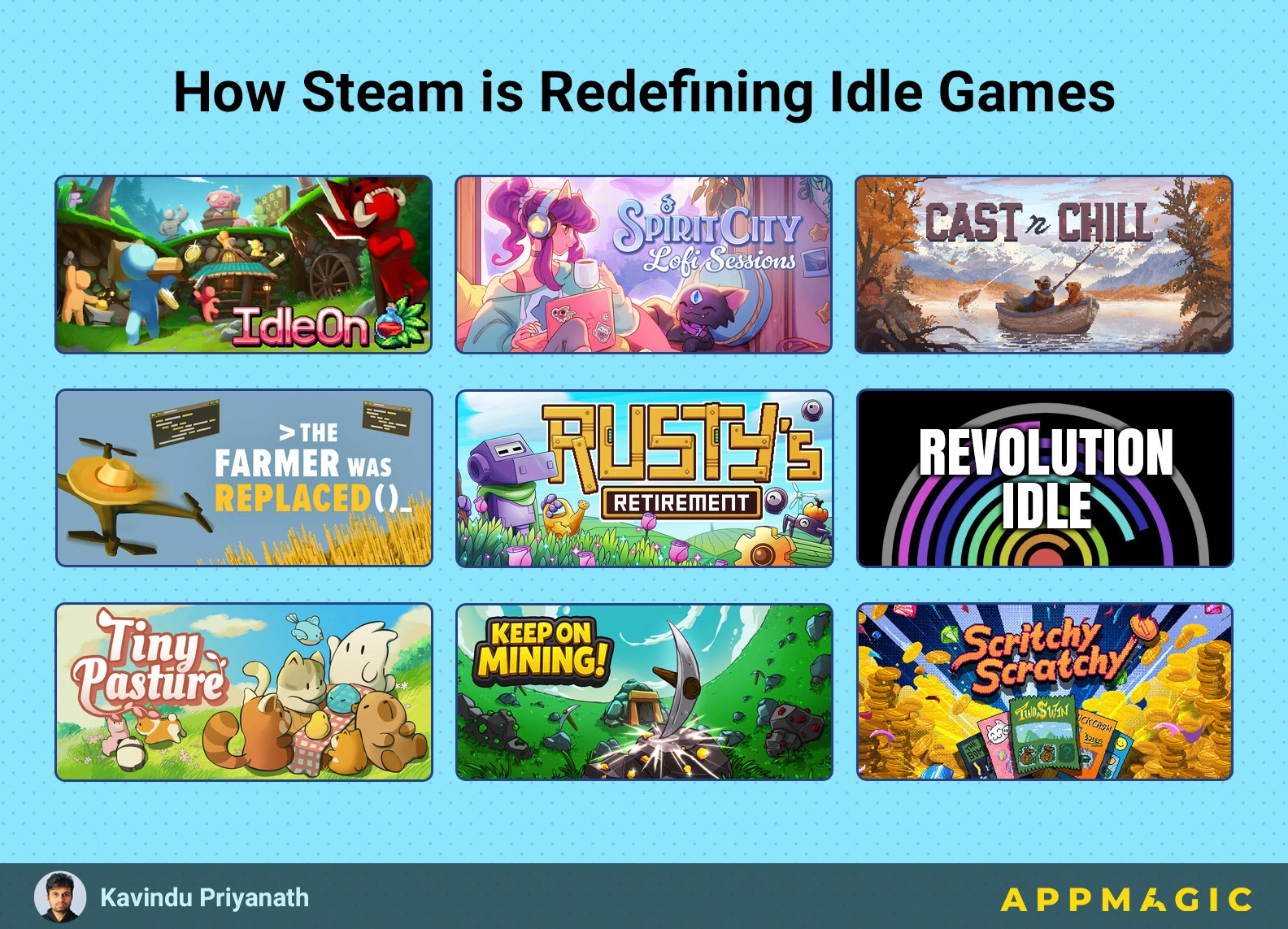
But there are exceptions. Games like The Farmer Was Replaced maintain over 10% D30 retention, while IdleOn generated over $22M in 2025 alone using a F2P model.
Genre Diversity
The definition of “Idle” is becoming increasingly blurry. What started with simple clicker-style games like Cookie Clicker has now evolved into mechanics that merge naturally with genres like RPGs, automations, simulations, and even productivity tools. This shift can even be seen in highly active games like Ball x Pit, which still adopt passive progression systems because Idle mechanics remain one of the most effective ways to drive long-term engagement
Mobile Vs Steam
On mobile, Idle games evolved toward deeper monetization, heavier LiveOps, and hybrid systems as pure Idle loops alone were no longer enough to sustain F2P model. Whiteout Survival building upon foundations similar to Frozen City is a great example of this evolution.
But on Steam, Idle games evolved differently. Instead of purely scaling monetization and complexity, the genre became stranger, more experimental, and far more niche. This is clearly visible through the wide variety of experiences emerging in the space, from desktop companions like Bongo Cat, to deeper automation systems like The Farmer Was Replaced, to layered progression ecosystems like IdleOn.
So what does this mean?
Even with more than 18K games releasing on Steam every year, the platform still gives small teams with weird experimental ideas a real chance to succeed. And its Idle ecosystem is one of the clearest examples of that.