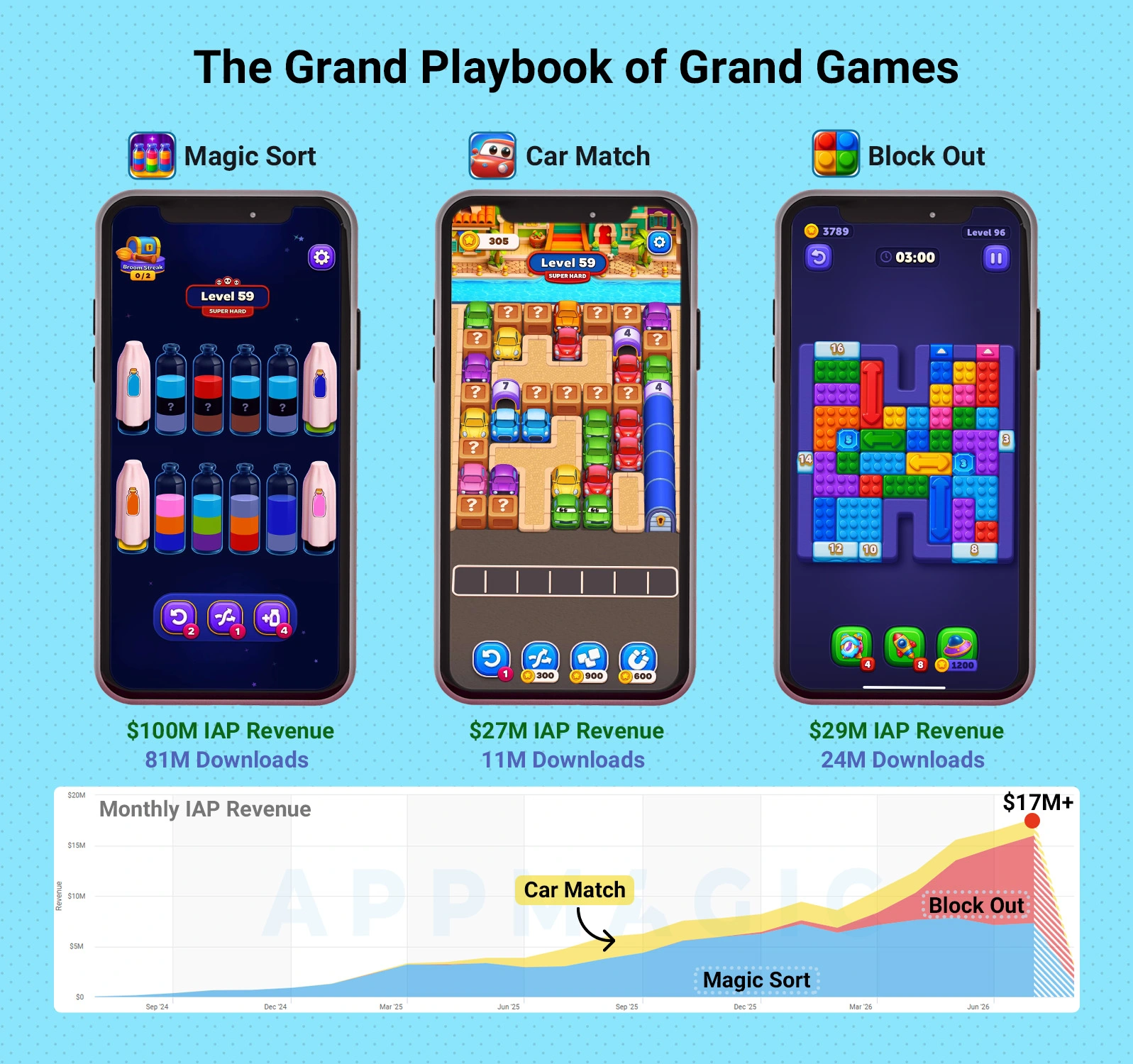
Grand Games made over $17M in IAP revenue last month alone.
This is a hybrid casual studio founded in 2024, with three global launches and, of course, a $100M+ investment.
And it all started with Magic Sort back in 2024.
The game wasn’t built around a groundbreaking new mechanic. Instead, it took the already established water-sort concept, which had largely been monetized through ads, and turned it into a more polished, casual experience. By the end of 2024, the game was climbing the charts and eventually became one of the biggest titles in Sort Puzzle subgenre, currently sitting second only to Pixel Flow.
Then came Car Match, which followed the same meta template Magic Sort used for progression, monetization and even LiveOps, while applying Grand’s signature quality to a car-themed iteration of Voodoo’s Block Jam 3D. Although the game never reached the same scale as Magic Sort, it has remained a solid performer ever since and currently has the highest RpD in Grand’s portfolio.
Then, in 2026, with Block Out, they once again reached the top charts, this time in block puzzle subgenre. Again, Grand reused their proven templates, combining their high quality execution and a core loop inspired by Rollic’s Color Block Jam. Today, this is not only Grand’s highest grossing game, but has also surpassed its predecessor, Color Block Jam, in monthly IAP revenue.
Together, these games highlight Grand’s ability to take established hyper or hybrid casual puzzle loops and turn them into more casualized experiences.
But when you look deeper, it’s not just about cloning another game and adding more polish.
Take Magic Sort. It automatically ends the level when player reaches a point where winning is no longer possible. Without this, player might not immediately realized the level is unwinnable and could waste more time trying to solve it. Instead, Grand stops the level at that exact moment and turns it into a monetization opportunity.
They do something similar with Block Out, gradually unlocking sections of the level as players progress. This makes larger puzzle easier to understand while lowering cognitive effort required from the player.
So, it’s about making proven concepts more accessible and approachable through smart design tweaks, on top of the polish, progression, monetization and LiveOps. And this might be one of the biggest differences between Grand’s success and the many other studios following the same trends.
Beyond its three biggest games, Grand has three other titles following proven loops like Block Blast, Pixel Flow, and Arrows puzzles. For now, it seems only the Arrows puzzle iteration, Maze Out, continues to receive updates.
So, the bigger question is:
Will Maze Out become Grand Games’ next breakout hit? Or will its next $100M contender come from an entirely different puzzle subgenre?