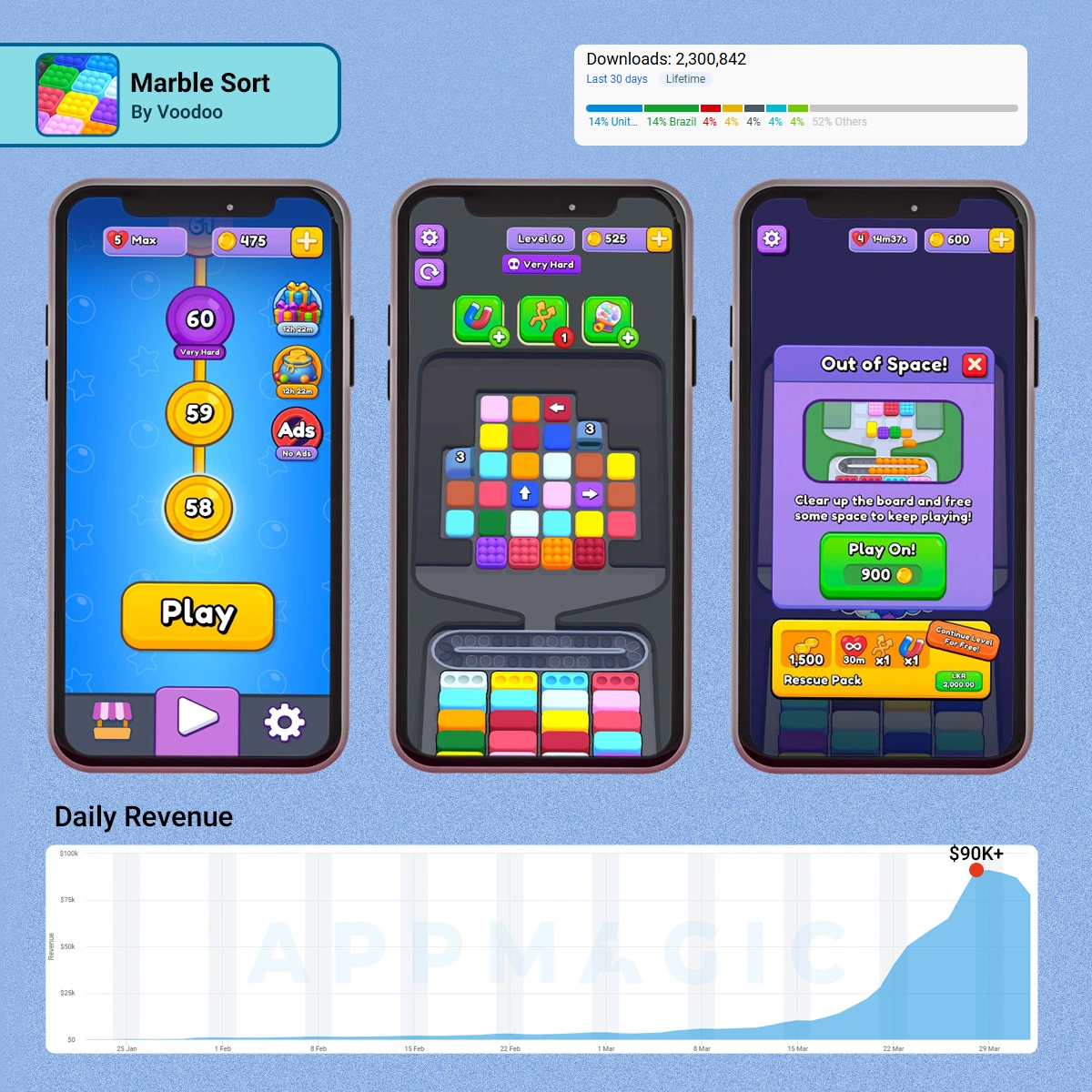
Marble Sort is a sort puzzle game by Voodoo, released in October 2025, and it has scaled to over $60K in daily IAP revenue, according to AppMagic.
Let’s break down the design behind this rising entry in the sort puzzle genre.
Gameplay Clarity
At its core, the game features a simple loop where players sort colored balls into 3-slot containers using a funnel and conveyor belt. Its clean visuals and satisfying physics-driven ball drops enhance the game feel, while the limited belt space adds a layer of strategic depth by forcing players to plan ahead and manage space. Tight situations, such as when the belt is nearly full, create moments of dexterity-based challenge where quick decisions matter, though physics can introduce slight randomness. Additionally, the game smartly prevents overfilling the funnel, keeping the puzzle state clear and readable.
Deterministic Puzzles
The game features deterministic puzzles, allowing players to learn, retry, and improve over time, while an early difficulty ramp encourages careful decision-making. It reinforces this through “Hard level” labeling on both the level map and via in-game visual theming, helping set clear player expectations. The game also uses a structured 2-step fail flow that first previews what a revival restores before presenting monetized offers. Additionally, new mechanics such as mystery boxes, extra slots, connected boxes, arrow boxes, and panels are introduced gradually, keeping the experience fresh and engaging.
IAP-driven Monetization
The game leans heavily into an IAP-first monetization, keeping ad usage minimal. Interstitials appear only after around level 30 to ensure smooth FTUE, and RV ads are limited to recovering a single life when players ran out of all hearts. The game creates economy pressure by keeping soft currency scarce and making boosters and revivals relatively expensive, further reinforced by the absence of reward multipliers, which slows resource accumulation. At the same time, IAPs are strongly integrated through fail offers, ad removal bundles, and value-driven packs combining currency, boosters and lives and different bundles in the in-game shop. Together, these systems nudge players toward spending to continue.
The game currently appears to be entering a decline phase in revenue, and with increasing competition in the sort puzzle genre, do you think this still have enough potential to scale further? Share your thoughts down below.
Original Post: Kavindu Priyanath-LinkedIn